






2025 Nobel Prize in Physics: Winners bridge quantum weirdness and the macroscopic world
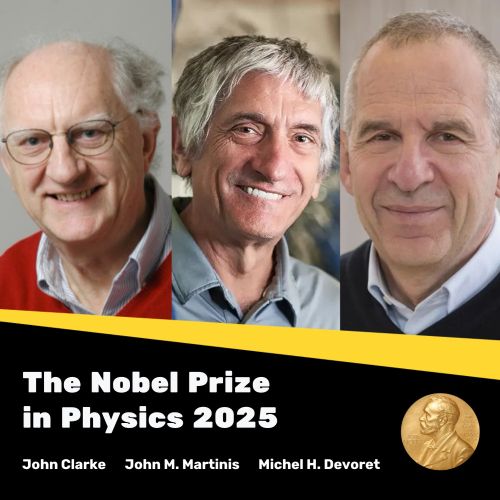
(October 7, 205) Today, the Royal Swedish Academy of Sciences awarded the Nobel Prize in Physics to John Clarke, Michel H. Devoret, and John M. Martinis “for the discovery of macroscopic quantum mechanical tunnelling and energy quantisation in an electric circuit.”
~
What the prize honors: Quantum mechanics is renowned for its counterintuitive predictions—particles can tunnel through barriers, and energy levels can be quantized. But historically these effects have been studied in microscopic systems (atoms, electrons, photons). The laureates’ experiments in the 1980s showed that these same quantum phenomena can manifest in circuits large enough to handle, bridging the gap between the quantum and classical physical worlds. They engineered superconducting circuits incorporating Josephson junctions to observe macroscopic quantum tunnelling—where the current in a superconducting loop escapes a metastable state through a quantum barrier.
The trio of scientists also demonstrated energy quantization in these circuits: energy is absorbed or emitted in discrete packets, consistent with quantum theory even at this larger scale. These discoveries formed the theoretical and experimental foundation for superconducting qubits, which are central to many current efforts in building scalable quantum computers.
~
The laureates & their affiliations:
- John Clarke is Professor Emeritus at the University of California, Berkeley. His work on superconducting quantum interference devices (SQUIDs) and quantum circuits laid much of the groundwork for the experiments honored by the prize.
- Michel H. Devoret holds roles at Yale University and the University of California, Santa Barbara. He is a leading contributor in circuit quantum electrodynamics (cQED), exploring how microwave photons interact with superconducting circuits.
- John M. Martinis is affiliated with the University of California, Santa Barbara. He was earlier involved with Google’s Quantum AI lab and has long explored the interface between quantum mechanics and superconducting technology. In the Nobel announcement, the committee underscored that their work “revealed quantum physics in action” — making tangible a realm of physics often thought to exist only in idealized microscopic systems.
~
Significance & future impact: This Nobel Prize underscores a profound shift: quantum mechanics is not confined to the atomic scale. The laureates showed that circuits you can hold can still obey the rules of the quantum world.
The experimental approach they pioneered is deeply relevant to quantum technologies now under active development:
- Quantum computing: Superconducting qubits remain among the most promising platforms, and much of today’s qubit design builds on the concepts first demonstrated by Clarke, Devoret, and Martinis.
- Quantum sensing: The sensitivity afforded by quantum mechanical phenomena in circuits could enhance measurements in magnetic sensing, imaging, and precision metrology.
- Quantum cryptography & communication: Understanding how to maintain quantum coherence at macroscopic scales is essential for future quantum networks.
The 2025 Nobel in Physics celebrates work that draws quantum behavior into the realm of practical engineering, demanding that we rethink the boundary between the microscopic and the macroscopic.
Congratulations to the 2025 Nobel Prize in Physics winners
Drs. John Clarke, Michel H. Devoret, and John M. Martinis!
The Nobel Prize in Physics was announced at the Royal Swedish Academy of Sciences in Stockholm, Sweden. See the announcement in the video below.
.
(Source: The Nobel Prize)
(Additional Sources: The Financial Times, Reuters, India Today, The Washington Post, The Associated Press)
Posted by Richard Webster, Ace News Today
Follow Richard on Facebook, Twitter & Instagram