






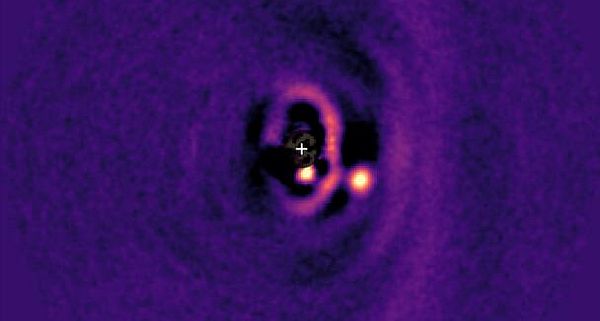
Astronomers capture first images of a baby planet growing in a ring of darkness
On August 26, University of Arizona News announced that a team of astronomers has detected for the first time a growing planet outside our solar system, embedded in a cleared gap of a multi-ringed disk of dust and gas.
The team, led by University of Arizona astronomer Laird Close and Richelle van Capelleveen, an astronomy graduate student at Leiden Observatory in the Netherlands, discovered the unique exoplanet using the University of Arizona’s MagAO-X extreme adaptive optics system at the Magellan Telescope in Chile, the U of A’s Large Binocular Telescope in Arizona and the Very Large Telescope at the European Southern Observatory in Chile. Their results are published in The Astrophysical Journal Letters.
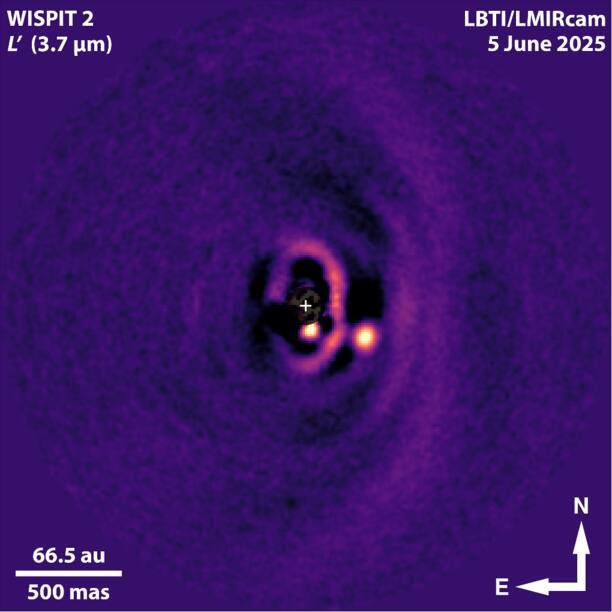
Photo of WISPIT 2b: The KLIP reduced L′ image from the LBT telescope with the LBTI LMIRcam instrument. The location of WISPIT 2b and the inner #3 and outer #2 dust rings are clear (despite the significant self-subtraction from KLIP). WISPIT 2b is located nearly in the center of the dust-free gap between the rings. The image is 143 × 143; see Appendix B for details about the L′ reduction.
For years, astronomers have observed several dozen planet-forming disks of gas and dust surrounding young stars. Many of these disks display gaps in their rings, hinting at the possibility that they are being “plowed” by nearby nascent planets, or protoplanets, like lanes being cleared by a snowplow. Yet, only about three actual young growing protoplanets have been discovered to date, all in the cavities between a host star and the inner edge of its adjacent protoplanetary disk. Until this discovery, no protoplanets had been seen in the conspicuous disk gaps – which appear as dark rings.
“Dozens of theory papers have been written about these observed disk gaps being caused by protoplanets, but no one’s ever found a definitive one until today,” said Close, professor of astronomy at the University of Arizona. He calls the discovery a “big deal,” because the absence of planet discoveries in places where they should be has prompted many in the scientific community to invoke alternative explanations for the ring-and-gap pattern found in many protoplanetary disks.
“It’s been a point of tension, actually, in the literature and in astronomy in general, that we have these really dark gaps, but we cannot detect the faint exoplanets in them,” he said. “Many have doubted that protoplanets can make these gaps, but now we know that in fact, they can.”
4.5 billion years ago, our solar system began as just such a disk. As dust coalesced into clumps, sucking up gas around them, the first protoplanets began to form. How exactly this process unfolded, however, is still largely a mystery. To find answers, astronomers have looked to other planetary systems that are still in their infancy, known as planet-forming disks, or protoplanetary disks.
Close’s team took advantage of an adaptive optics system, one of the most formidable of its kind in the world, developed and built by Close, Jared Males and their students. Males is an associate astronomer at Steward Observatory and the principal investigator of MagAO-X. MagAO-X, which stands for “Magellan Adaptive Optics System eXtreme,” dramatically improves the sharpness and resolution of telescope images by compensating for atmospheric turbulence, the phenomenon that causes stars to flicker and blur, and is dreaded by astronomers.
Suspecting there should be invisible planets hiding in the gaps of protoplanetary disks, Close’s team surveyed all the disks with gaps and probed them for a specific emission of visible light known as hydrogen alpha or H-alpha.
“As planets form and grow, they suck in hydrogen gas from their surroundings, and as that gas crashes down on them like a giant waterfall coming from outer space and hits the surface, it creates extremely hot plasma, which in turn, emits this particular H-alpha light signature,” Close explained. “MagAO-X is specially designed to look for hydrogen gas falling onto young protoplanets, and that’s how we can detect them.”
The team used the 6.5-meter Magellan Telescope and MagAO-X to probe WISPIT-2, a disk van Capelleveen recently discovered with the VLT. Viewed in H-alpha light, Close’s group struck gold. A dot of light appeared inside the gap between two rings of the protoplanetary disk around the star. In addition, the team observed a second candidate planet inside the “cavity” between the star and the inner edge of the dust and gas disk.
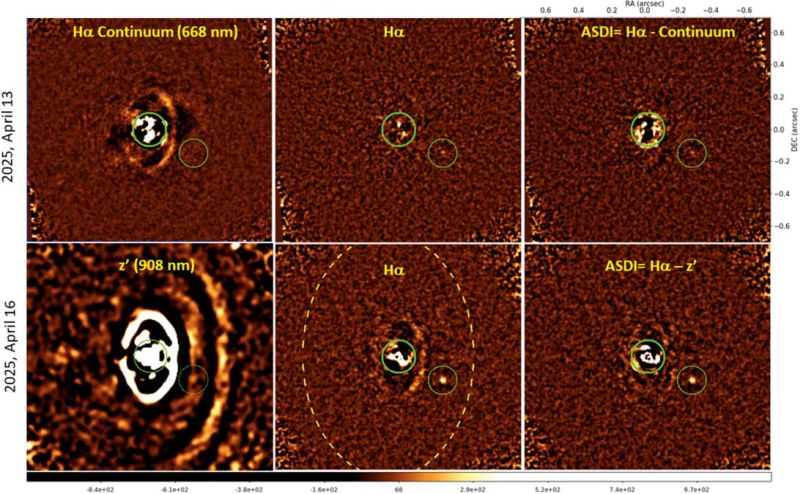
The discovery images of WISPIT 2b. These are both the 2025 April MagAO-X Hα pyKLIP pipeline reduced data sets. The thick central green circles (r = 103 mas) are centered on the star. The lighter-green circles (r = 89 mas) all have identical centers at WISPIT 2b (star–planet separation = 309.43 mas, PA = 2422). In the discovery image, WISPIT 2b is detected in the ASDI image at a signal-to-noise ratio (SNR) = 5.5 (top right), on April 16 it was recovered at SNR = 12.5 (bottom right). The dashed yellow line in the Hα image traces the second-brightest ring (visible at z′; called ring #2; the brightest inner ring is ring #3; see Letter 1 for ring images and names). All images have the first 5 principal component (PC) modes removed by pyKLIP with movement set to zero. Images are 1518 × 1388 mas, smoothed by an FWHM = 17 mas Gaussian (except the z′ image, which has a 29 mas smoothing and pyKLIP movement = 5, and a deeper stretch). North is up, and east is left in these, and all following, images.
“Once we turned on the adaptive optics system, the planet jumped right out at us,” said Close, who called this one of the more important discoveries in his career. “After combining two hours’ worth of images, it just popped out.”
According to Close, the planet, designated WISPIT 2b, is a very rare example of a protoplanet in the process of accreting material onto itself. Its host star, WISPIT 2 is similar to the sun and about the same mass. The inner planet candidate, dubbed CC1, contains about nine Jupiter masses, whereas the outer planet, WISPIT 2b, weighs in at about five Jupiter masses. These masses were inferred, in part, from the thermal infrared light observed by the University of Arizona’s 8.4-meter Large Binocular Telescope on Mount Graham in Southeastern Arizona with the help of U of A astronomy graduate student Gabriel Weible.
“It’s a bit like what our own Jupiter and Saturn would have looked like when they were 5,000 times younger than they are now,” Weible said. “The planets in the WISPIT-2 system appear to be about 10 times more massive than our own gas giants and more spread out. But the overall appearance is likely not so different from what a nearby ‘alien astronomer’ could have seen in a ‘baby picture’ of our solar system taken 4.5 billion years ago.”
“Our MagAO-X adaptive optics system is optimized like no other to work well at the H-alpha wavelength, so you can separate the bright starlight from the faint protoplanet,” Close said. “Around WISPIT 2 you likely have two planets and four rings and four gaps. It’s an amazing system.”
CC1 might orbit at about 14-15 astronomical units – with one AU equaling the average distance between the sun and Earth, which would place it halfway between Saturn and Uranus, if it was part of our solar system, according to Close. WISPIT-2b, the planet carving out the gap, is farther out at about 56 AU, which in our own solar system, would put it well past the orbit of Neptune, around the outer edge of the Kuiper Belt.
A second paper published in parallel and led by van Capelleveen and the University of Galway details the detection of the planet in the infrared light spectrum and the discovery of the multi-ringed system with the 8-meter VLT telescope’s SPHERE adaptive optics system.
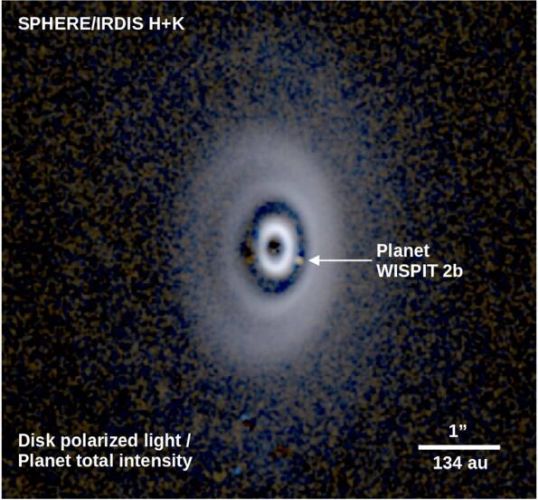
Shown here is a SPHERE/IRDIS multiband image of the WISPIT 2 system. The H-band Qϕ image was added as the blue channel and the median combination of H-band and Ks-band Qϕ images was added as the green channel. The red channel is a combination of a Ks-band Qϕ image and a Ks-band cADI image in which we masked all but the gap containing the thermal emission from WISPIT 2b.
“To see planets in the fleeting time of their youth, astronomers have to find young disk systems, which are rare,” van Capelleveen said, “because that’s the one time that they really are brighter and so detectable. If the WISPIT-2 system was the age of our solar system and we used the same technology to look at it, we’d see nothing. Everything would be too cold and too dark.”
This research was supported in part by a grant from the NASA eXoplanet Research Program. MagAO-X was developed in part by a grant from the U.S. National Science Foundation and by the generous support of the Heising-Simons Foundation
Video:
~
(Source and images: University of Arizona News)
Posted by Richard Webster, Ace News Today
Follow Richard on Facebook, Twitter & Instagram