







Interstellar object 3I/ATLAS: Alien space probe or run-of-the-mill space rock?

In 2025, scientists along with the general public on planet Earth have been captivated by a rare cosmic visitor: an interstellar object known as 3I/ATLAS. Discovered in July, it is only the third confirmed object from beyond our solar system to make a close pass by the Sun — and its behavior has sparked both serious scientific inquiry and a speculative leap into the realm of alien technology.
The more sensational ideas around 3I/ATLAS were largely driven by Harvard astrophysicist Avi Loeb, who proposed that the comet’s unusual motion and appearance might not be entirely natural. Loeb argued in a thought-experiment paper that the object could represent an artificial space probe, perhaps sent by a distant intelligence to explore our solar system. according to People.
Loeb’s key arguments hinged on:
- Non-gravitational acceleration: As 3I/ATLAS sped through the inner solar system, it exhibited tiny but measurable accelerations that couldn’t be explained by gravity alone. The New York Post shared that Loeb suggested this might indicate a hidden propulsion system, not just outgassing.
- Color shifts: Instruments near the Sun (including spacecraft) reportedly saw the object “turn bluer than the Sun,” which Loeb said could hint at artificial lighting or highly energetic processes.
- Mass-loss estimates: Based on the observed acceleration, Loeb calculated that the object would have to shed a large fraction of its mass — more than 10 percent — to generate enough thrust by natural cometary outgassing.
- Apparent lack of a tail: Some post-perihelion images showed a compact, point-like source with no obvious cometary tail. For Loeb, that absence was striking given the expected mass loss.
Taken together, the above anomalies fueled speculation that 3I/ATLAS might be more spacecraft than space rock.
~
Image Gallery
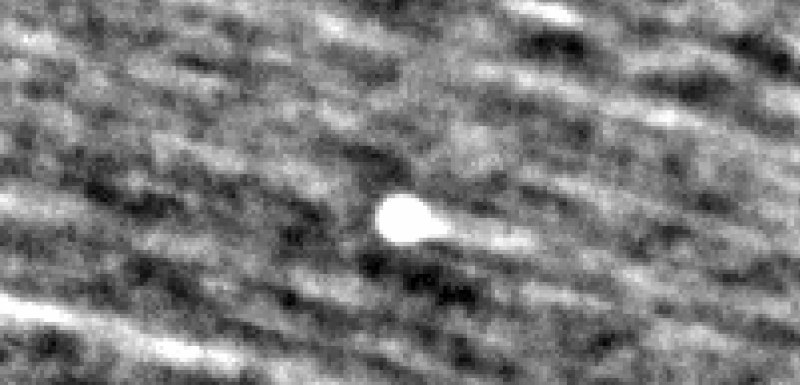
3I/ATLAS appears as a bright object near the center of this image, made from combining observations from NASA’s PUNCH mission taken from Sept. 20 to Oct. 3, 2025, when the comet was about 231 million to 235 million miles from Earth. Its tail appears as a short elongation to the right. Stars appear as streaks in the background. Image credit: NASA/Southwest Research Institute
–
Movie

Movie shows PUNCH’s observations of comet 3I/ATLAS from Sept. 28 to Oct. 10, 2025, when the comet was between 231 million to 235 million miles from Earth. Each frame is a daily stacked image, made up of multiple observations taken of the comet each day. Stars create streaks of light in the background as the comet moves across the sky. The bright object that appears near the comet in a couple of frames is the planet Mars. Image credit: NASA/Southwest Research Institute
~
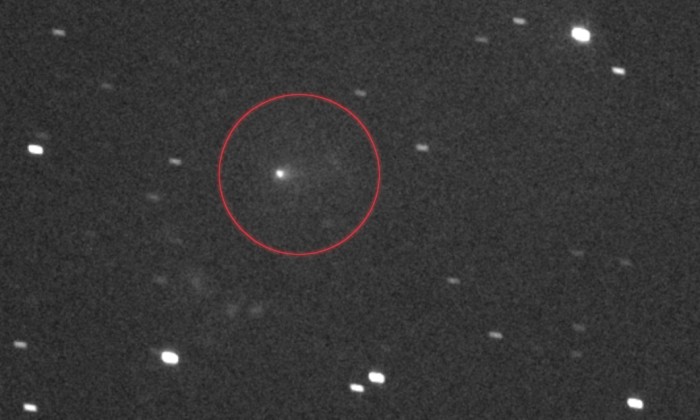
3I/ATLAS, circled in the center, as seen by the L’LORRI panchromatic, or black-and-white, imager on NASA’s Lucy spacecraft. This image was made by stacking a series of images taken on Sept. 16, 2025, as the comet was zooming toward Mars. Lucy was 240 million miles away from 3I/ATLAS at the time making its way to explore eight asteroids that share an orbit with Jupiter. The L’LORRI imager captured the comet’s coma, the fuzzy halo of gas and dust surrounding 3I/ATLAS above, and its tail, a smudge of gas flowing to the right of the comet. Image credit: NASA/Goddard/SwRI/JHU-APL
~
~
The strange thing about 31/ATLAS, is that it really does display unusual behavior. Beyond the alien conspiracy theory, astronomers have noted several genuinely odd features associated with this comet:
- Non-gravitational acceleration: Astronomers modeled the comet’s motion and detected deviations from a purely gravitational trajectory. While such deviations are common in comets (due to outgassing), the magnitude and direction of 3I/ATLAS’s acceleration prompted closer examination, according to Cornell University.
- Unusual gas composition: Observations with the James Webb Space Telescope (JWST) revealed a coma (the cloud of gas surrounding the nucleus) dominated by carbon dioxide (CO₂), with surprisingly high CO₂-to-H₂O ratios — much higher than typical solar system comets.
- Extreme polarization: Polarimetric studies (which measure how light scattering is polarized) show 3I/ATLAS has an unusually deep negative polarization branch, deeper than seen in most known comets.
- Jet activity: There is evidence of strong jets of material, possibly directed sunward (an “anti-tail”), which is rare and could indicate highly directional outgassing.
- Radio emissions, but not aliens: The MeerKAT telescope in South Africa detected radio signals from 3I/ATLAS. However, rather than alien transmissions, these appear to originate from hydroxyl (OH) radicals, a by-product of water molecules breaking down — exactly the kind of outgassing process seen in comets, as discussed on Live Science.
- No catastrophic disintegration: Despite intense jet activity and mass loss, 3I/ATLAS seems to have remained intact after its closest approach to the Sun (perihelion), according to follow-up imaging.
These unusual but natural-seeming behaviors have kept scientists on their toes.
~
Thanks to a wealth of new observations sparked by all the interest surrounding 31/ATLAS, the astronomical community has arrived at a consensus about what it actually is – and it’s not aliens.
“3I/ATLAS is a natural comet, not a spacecraft.” ~ NASA
Just this month, NASA released close-up images from multiple spacecraft (including Mars orbiters) showing 3I/ATLAS as a fuzzy, diffuse comet with a coma and tail structure typical of cometary bodies. Scientists modeled its acceleration and found that anisotropic (directional) outgassing of conventional volatiles like CO and CO₂ can explain its motion, without invoking exotic or artificial forces.
Infrared spectroscopy (e.g., with JWST) points to a CO₂-rich nucleus, a plausible signature for a comet formed in a different star system, rather than anything engineered.
Based on composition and trajectory, 3I/ATLAS may have originated in an older star system. NASA scientists have noted that studying it offers a window into a very distant and ancient region of our galaxy. The radio signals are natural ones. The detected radio emissions correspond to the breakdown products of water, consistent with classic cometary outgassing — not a communication beacon.
In short, the “alien probe” hypothesis, while attention-grabbing, does not hold water. Instead, 3I/ATLAS is likely a very unusual but still natural interstellar comet, offering scientists a rare opportunity to study material from another star system up close.
Still of great interest to scientists and lay people alike, this comet’s flyby is a once-in-a-lifetime event. According to NASA, it will not return. That makes every observation — from radio telescopes to Mars orbiters — extremely valuable.
Video:
.
(Additional sources: The Associated Press, JPL, PBS)
(Cover photo: Image shows the 3I/ATLAS interstellar comet as a bright, fuzzy orb in the center. Traveling through our solar system at a staggering 130,000 miles per hour. Image was captured in a series of colorized stacked images from Sept. 11-25, using the Heliocentric Imager-1 instrument, a visible-light imager on the STEREO-A (Solar Terrestrial Relations Observatory) spacecraft. Image credit: NASA/Lowell Observatory/Qicheng Zhang)
Posted by Richard Webster, Ace News Today
Follow Richard on Facebook, Twitter & Instagram