






Blue Origin launches NASA’s dual spacecraft to study Mars’ magnetic mysteries
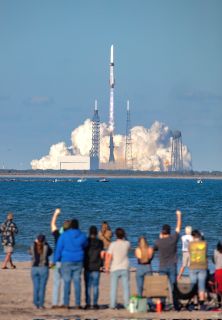
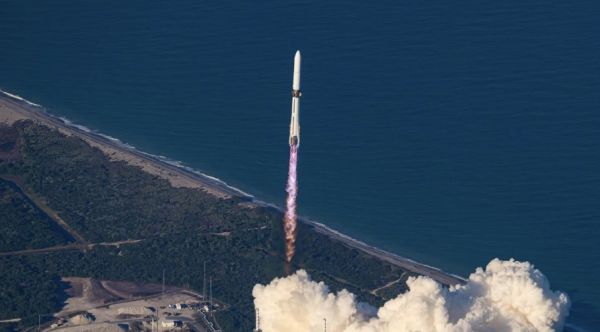
On November 13, NASA launched a pair of pioneering spacecraft toward a multi-year mission that will investigate how the Sun’s intense radiation and energetic particles have transformed Mars over billions of years. The dual ESCAPADE probes—short for Escape and Plasma Acceleration and Dynamics Explorers—lifted off Thursday at 3:55 p.m. EST, aboard a Blue Origin New Glenn rocket from Launch Complex 36 at Cape Canaveral Space Force Station.
The mission, led by the University of California, Berkeley, and built by Rocket Lab, seeks to better understand how the solar wind carved away much of Mars’ ancient atmosphere, eventually turning a once-warm planet with flowing water into the frozen desert seen today.
“This heliophysics mission will help reveal how Mars became a desert planet, and how solar eruptions affect the Martian surface,” said acting NASA Administrator Sean Duffy. “Every launch of New Glenn provides data that will be essential when we launch MK-1 through Artemis. All this information will be critical to protect future NASA explorers and invaluable as we evaluate how to deliver on President Trump’s vision of planting the Stars and Stripes on Mars.”
By 10:35 p.m., mission controllers confirmed stable communication with both spacecraft.
~
Studying Space Weather—For Robots and Future Astronauts: The twin probes will observe how solar storms and the solar wind interact with the Martian environment—insights critical to designing systems that can withstand extreme radiation during future human missions.
“Understanding Martian space weather is a top priority for future missions because it helps us protect systems, robots, and most importantly, humans, in extreme environments,” said Nicky Fox, associate administrator for NASA’s Science Mission Directorate.
Recent heightened solar activity, which triggered widespread auroras across Earth, caused NASA to briefly delay the launch to ensure that solar storms would not disrupt early spacecraft checkouts. The same space weather phenomena that complicate launches will become key areas of scientific focus once ESCAPADE reaches Mars.
A Never-Before-Flown Journey: Unlike past Mars missions that launched during a narrow planetary alignment window, ESCAPADE is pioneering an “Earth-proximity” loiter orbit. The spacecraft will first travel to the Sun-Earth Lagrange Point 2, one million miles from Earth, and wait until November 2026—when Earth and Mars are aligned more favorably. The probes will then slingshot back toward Earth and use its gravity to accelerate toward Mars.
“The ESCAPADE spacecraft are now about to embark on a unique journey to Mars never traversed by any other mission,” said Alan Zide, program executive at NASA Headquarters.
This looping trajectory will also make ESCAPADE the first mission ever to pass through the distant region of Earth’s magnetotail, a stretched portion of the planet’s magnetic field pushed outward by the solar wind.
Dual Spacecraft, Dual View of Mars: After arriving at Mars in September 2027, the probes will begin the first coordinated two-spacecraft orbital study of another planet. Their science campaign will unfold in two phases:
- Phase 1 — “String-of-Pearls” Formation (Begins June 2028) – The probes will follow each other closely through identical paths, sampling the same regions of space just minutes apart. This stereo-style observation will reveal how rapidly Martian space weather changes.
- Phase 2 — Split Orbits (Five Months) – One spacecraft moves to a higher, more distant orbit while the other stays closer to the planet. Together, they will simultaneously measure the incoming solar wind and Mars’ reaction to it—providing a complete picture of how the planet’s upper atmosphere is stripped away.
The mission will also study Mars’ ionosphere, a crucial region future astronauts will rely on for radio communications and navigation.
More Than Mars: Additional Payload Onboard: New Glenn also carried a Viasat space-communications technology demonstration funded by NASA’s Communications Services Project. The payload relayed launch telemetry from the rocket’s second stage via Viasat’s geostationary network—part of NASA’s long-term plan to transition routine communications services to commercial partners.
More information about ESCAPADE can be found at NASA’s mission homepage.
And for more on the November 13, 2025, Mars launch, see the video below.
.
(Source: NASA)
(Cover photo: NASA’s ESCAPADE mission launched atop a Blue Origin New Glenn rocket from Cape Canaveral in Florida. Image credit: Blue Origin)
Posted by Richard Webster, Ace News Today
Follow Richard on Facebook, Twitter & Instagram