






Scientists may have just spotted the first direct evidence of dark matter
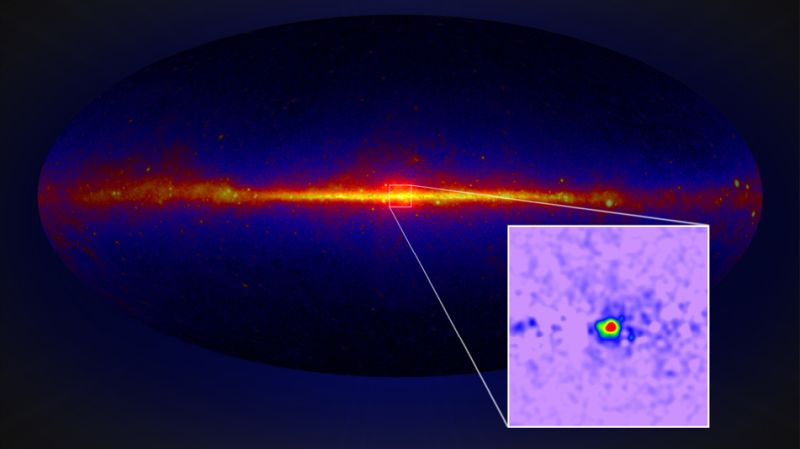
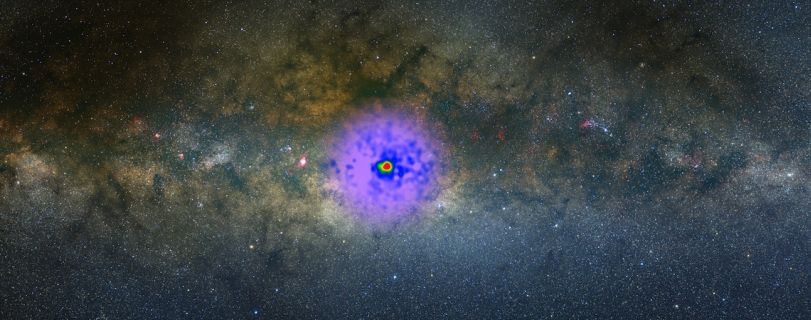
These are exciting times in the science world for legit researchers covering outer space and the cosmos, now that a team led by Tomonori Totani at University of Tokyo just announced a potential breakthrough: the first direct, visible, detection of Dark Matter. According to BBC – Science Focus, the study — based on more than 15 years of observations from Fermi Gamma-ray Space Telescope — reports a halo-shaped glow of gamma rays at the center of our galaxy whose properties line up remarkably well with those expected from dark-matter particles annihilating each other.
These are also exciting times for sci-fi enthusiasts like me who think that this stuff is awesome, although some of us may not really understand it all. To that end, I’d like to share the following:
What exactly is Dark Matter?
The way my close personal friends at NASA explain it: “Dark Matter is a mysterious, invisible kind of matter in the universe that does not emit, absorb, or reflect light — so we can’t see it directly.” Scientists know it’s real because of its gravitational pull. The motions of stars in galaxies, and how galaxies cluster together, behave as if there is much more mass present than the matter we can see.
In fact, ordinary “visible” matter — stars, planets, gas, and dust — makes up only a small fraction of the universe. Dark matter is thought to account for about 27% of the universe’s total mass–energy content. Because dark matter interacts (so far as we can tell) only through gravity, it acts like a kind of “cosmic glue.” It helps hold galaxies and galaxy clusters together and gives structure to the Universe on the largest scales.
Put simply: dark matter is the invisible stuff that makes up most of the matter in the universe — we can’t see it, but we see its effects everywhere.
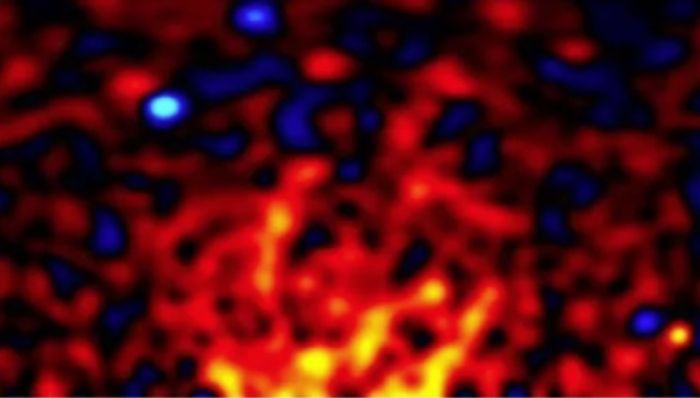
Totani’s team identified gamma-ray emissions with photon energies around 20 gigaelectronvolts (GeV) coming from a diffuse, spherical—or “halo-like”—region near the core of the Milky Way. According to Copernical, the shape, energy spectrum, and spatial distribution of this signal match theoretical predictions for collisions (annihilations) between hypothetical dark-matter particles known as WIMPs — weakly interacting massive particles, thought to be roughly 500 times heavier than a proton.
According to Totani, “the gamma-ray emission component closely matches the shape expected from the dark matter halo.” ~ Anadolu Ajansi – Science Technology
~
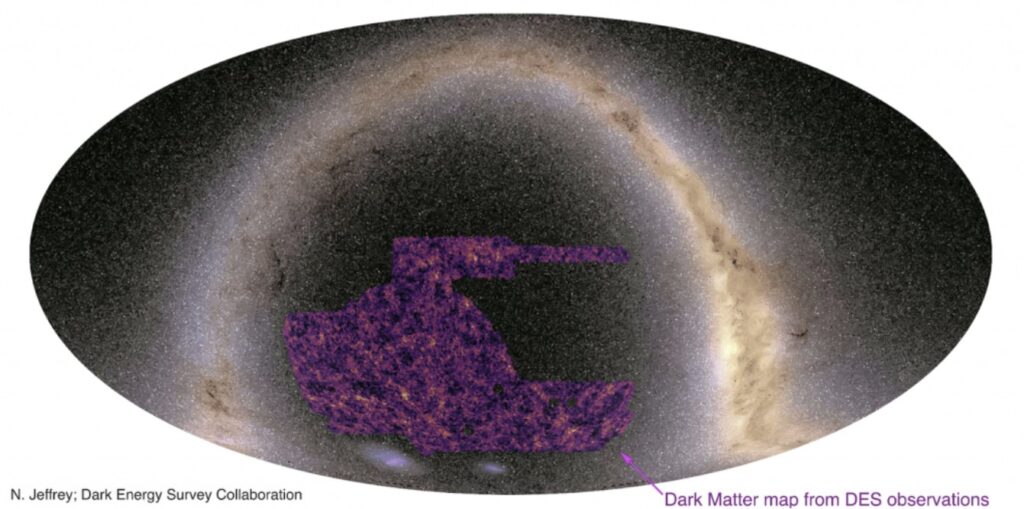
If confirmed, this detection of the dark stuff spearheaded by Totani would represent the first-time scientists have “seen” dark matter — not via gravitational effects as in past studies, but through an energetic signal produced by dark-matter particles themselves. It would be a major step forward in understanding the true nature of most of the matter in the Universe — matter that so far has remained invisible.
A successful confirmation could mean dark matter is not just a gravitational placeholder, but a new type of particle outside the standard model of particle physics, according to Forbes.
While these findings are compelling, the researchers themselves along with much of the scientific community are urging caution. Alternative astrophysical sources (e.g., certain populations of pulsars) have long been proposed to explain gamma-ray excesses near the galactic center, and such explanations cannot yet be ruled out conclusively, according to The Guardian.
NDTV and Forbes write that, to move from “possible evidence” to “confirmed discovery,” scientists will need independent verification: similar gamma-ray signatures from other dark-matter–rich environments (like dwarf galaxies), consistency across different instruments, and exhaustive exclusion of ordinary astrophysical sources.
At the very least, Totani and his colleagues have delivered one of the most concrete dark-matter candidates to date — a finding that could re-shape our understanding of the universe.
For more on the story, see the video below.
~
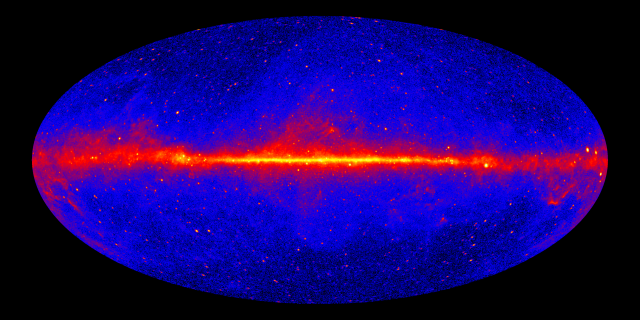
Cover photo: An all-sky gamma-ray map compiled from 12 years of observations by NASA’s Fermi Gamma-ray Space Telescope. The bright red and yellow band across the center traces intense high-energy emissions from the plane of the Milky Way, while the surrounding blue regions show fainter gamma-ray background across the rest of the sky. Image credit: NASA
Posted by Richard Webster, Ace News Today
Follow Richard on Facebook, Twitter & Instagram