





A new look at TRAPPIST-1e, an Earth-sized world in the ‘Goldilocks Zone’
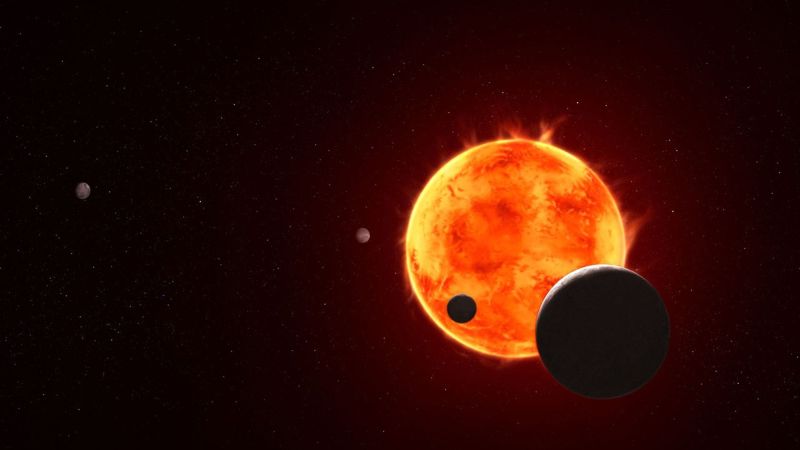
(TRAPPIST-1 e, depicted at the lower right, is silhouetted as it passes in front of its flaring host star in this artist’s concept of the TRAPPIST-1 system. Scientists call this event a transit, when valuable data can be gathered as the exoplanet passes between the star and the telescope and starlight illuminates the atmosphere, if one is present. Image credit: NASA Science)
Scientists at the University of Arizona say new observations of TRAPPIST-1e — one of seven Earth-sized planets orbiting a nearby red dwarf star — are offering fresh clues about whether the planet could support life.
TRAPPIST-1e sits in the star’s habitable zone, where temperatures could allow liquid water. But that depends entirely on whether the planet has an atmosphere, and right now, researchers aren’t sure it does.
Using NASA’s James Webb Space Telescope, a team led by UArizona scientist Sukrit Ranjan analyzed four transits of the planet and detected faint hints of methane — a possible atmospheric signature. But the star, an ultracool red dwarf about 39 light-years away, is tricky to study. Its own methane-like signals may be contaminating the data.
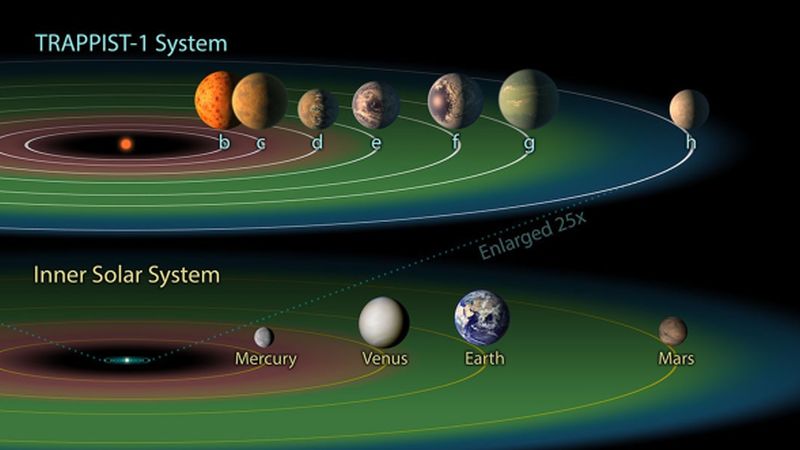
“Our results suggest the methane signal may simply be noise from the host star,” Ranjan said. “That doesn’t rule out an atmosphere — we just need more observations.”
TRAPPIST-1e is one of the closest potentially Earth-like planets known, making it a prime target for Webb and upcoming missions. NASA’s Pandora satellite, launching in 2026, is expected to help separate planetary signals from stellar activity.
For now, the question at the heart of the search remains open: does TRAPPIST-1e have an atmosphere — and could it be a habitable world? For more on this exciting possibility, see the video accompanying this article.
.
(Source: University of Arizona)
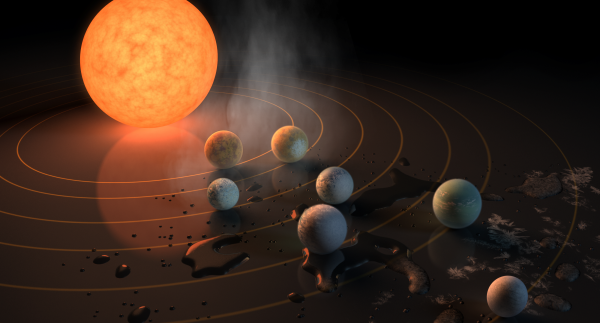
(“Planetary System” cover photo: Artist’s concept portrays the seven rocky exoplanets within the Trappist-1 system, located 40 light-years from Earth. Astronomers will observe these worlds with Webb in an effort to detect the first atmosphere of an Earth-sized planet beyond our solar system. Image credit: NASA Science)
Posted by Richard Webster, Ace News Today
Follow Richard on Facebook, Twitter & Instagram