






Astronomers measure Black Hole ‘mind blowing’ jet power for first time, revealing ‘dancing’ beams approaching light speed
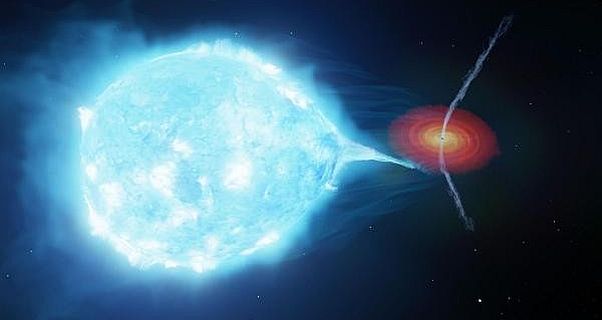
The strong stellar wind from the supergiant star pushes the jets launched by the black hole away from the star. This causes the jet direction to vary as the black hole and the supergiant star move around their orbit. (Image credit: ICRAR/Curtin University)
Astronomers have, for the first time, directly measured the instantaneous power and speed of jets blasting from a black hole, offering a breakthrough glimpse into one of the universe’s most extreme phenomena.
The international research team focused on Cygnus X-1, a well-known binary system about 7,200 light-years from Earth that pairs a black hole with a massive blue supergiant star. Using high-resolution observations gathered over nearly two decades from a global network of radio telescopes, scientists determined that the black hole’s jets carry energy equivalent to roughly 10,000 suns.
The jets themselves were clocked at staggering speeds—about 355 million miles per hour, or nearly half the speed of light—confirming their status among the fastest and most energetic structures in the cosmos.
In a surprising twist, researchers found the jets are not rigid beams but instead appear to “dance” through space. Powerful stellar winds from the companion star push against the jets, bending and shifting their direction as the two objects orbit each other every 5.6 days. This interaction allowed scientists to calculate the jets’ real-time power for the first time, rather than relying on long-term averages.
Cygnus X-1 holds special significance as the first black hole ever identified, and the new findings deepen understanding of how such objects behave. The study also revealed that about 10% of the energy generated as matter falls toward the black hole is redirected into these jets, which can extend for light-years and influence surrounding space.
Researchers say the breakthrough provides a new way to “balance the energy budget” of black holes—measuring how much energy they consume versus how much they eject. This insight is key to understanding how black holes shape galaxies, drive cosmic turbulence, and influence the evolution of the universe itself.
The team hopes to apply the same techniques to other black hole systems, potentially opening a new era of precision measurements in astrophysics. For more on this major breakthrough in astrophysics, see the video accompanying this article.
~
(Sources: Orange County Register via The Associated Press, Science Alert, Times Now)
Posted by Richard Webster, Ace News Today
Follow Richard on Facebook, Twitter & Instagram