






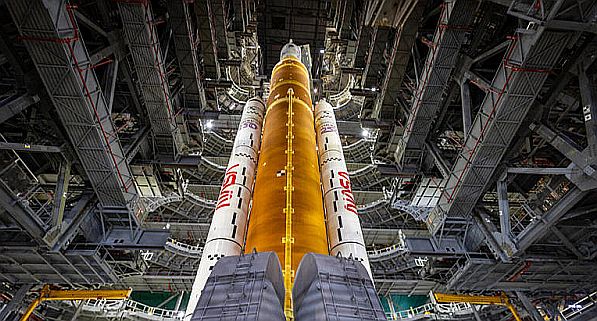
‘All Systems Go’ as NASA targets April 1 launch for historic Artemis II Moon Mission
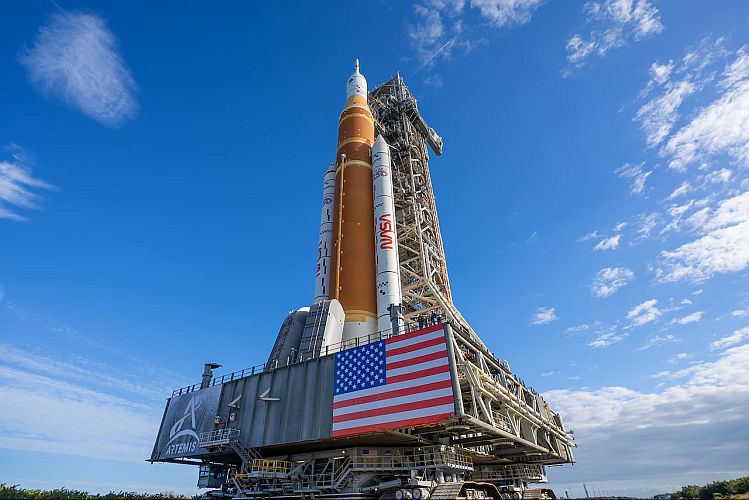
NASA is preparing for a potentially historic return to deep-space human exploration, targeting April 1, 2026, for the launch of Artemis II, the first crewed mission to fly around the moon since the Apollo era more than five decades ago.
Following a two-day Flight Readiness Review on March 12, NASA officials said all teams gave a preliminary “go” to proceed toward launch. The agency plans to roll the massive Space Launch System (SLS) rocket and Orion spacecraft to Launch Pad 39B at Kennedy Space Center in Florida on March 19, pending completion of final preparations.
If all goes according to plan, the rocket will lift off at 6:24 p.m. EDT, sending four astronauts on a nine-day journey around the moon before splashing down in the Pacific Ocean.
The mission will carry NASA astronauts Reid Wiseman, Victor Glover, and Christina Koch, along with Canadian Space Agency astronaut Jeremy Hansen, on a “free-return” trajectory that will take them around the far side of the moon before lunar gravity slingshots the spacecraft back toward Earth.

Delays and Technical Concerns: The mission has already faced significant delays and technical challenges, raising scrutiny around NASA’s ambitious Artemis program.
Originally planned for early February, the launch slipped after engineers detected hydrogen fuel leaks during testing and later discovered a helium pressurization system problem in the rocket’s upper stage. The issues forced NASA to roll the rocket back from the launch pad to the Vehicle Assembly Building, where engineers replaced seals and repaired the faulty components.
Officials say the fixes appear successful; but Artemis II remains a test flight with inherent risk, particularly because it will be the first crewed flight of the SLS rocket and Orion spacecraft following only a single uncrewed mission in 2022.
NASA has not released a precise risk estimate for the mission. Internal analyses suggest overall mission risk could be roughly 1 in 30, although officials caution such numbers are difficult to quantify for a spacecraft with limited flight history.
Why Artemis II is Important: Despite the challenges, Artemis II is considered a critical milestone in NASA’s long-term strategy to return humans to the moon and to eventually reach Mars.
The mission will test Orion’s life-support, navigation, communications, and flight control systems with astronauts onboard for the first time. At its closest approach, the crew will travel about 4,100 miles above the lunar surface and reach a distance of roughly 252,800 miles from Earth, farther than any humans have traveled in space.
Success would pave the way for Artemis III and later missions, which are expected to test lunar landing systems and ultimately return astronauts to the moon’s surface for the first time since Apollo 17 in 1972.
NASA leaders say the stakes are high.
“This is a test flight, and it is not without risk,” officials said during the readiness briefing. “But our team and hardware are ready.”
If Artemis II launches within its early April window, NASA will analyze data from the mission to prepare for future lunar landing attempts later this decade, a key step toward establishing a sustained human presence on the moon.
For more on this potentially historic return to deep-space human exploration, see the video below.
~
(Sources: NASA Press Release, CBS News, Fox News)
Posted by Richard Webster, Ace News Today
Follow Richard on Facebook, Twitter & Instagram