






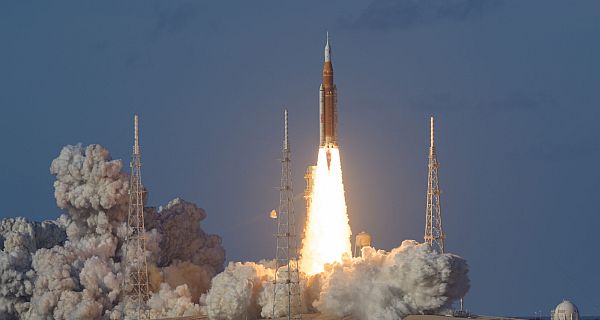
NASA’s Artemis II successfully lifts off, launching first crewed moon mission in over 50 years
In a defining moment for modern space exploration, NASA’s Artemis II mission roared to life Wednesday evening, sending four astronauts on the first crewed journey toward the Moon in more than half a century. The towering Space Launch System (SLS) rocket lifted off at 6:35 p.m. EDT from Kennedy Space Center, carrying the Orion spacecraft and its international crew on a bold mission that signals humanity’s long-awaited return to deep space.
Aboard Orion are NASA astronauts Reid Wiseman, Victor Glover, and Christina Koch, alongside Canadian Space Agency astronaut Jeremy Hansen. Their nearly 10-day mission will take them farther from Earth than any humans have traveled in decades, looping around the Moon before returning for a Pacific Ocean splashdown. The flight is not only a technological test, but also a symbolic milestone, with Glover becoming the first Black astronaut on a lunar mission, Koch the first woman, and Hansen the first Canadian to make the journey.

Moments after liftoff, Orion successfully reached orbit and deployed its solar arrays, beginning a carefully choreographed series of system checks. The spacecraft will spend roughly 24 hours in Earth orbit before executing a critical translunar injection burn, sending the crew toward the Moon. During the mission, astronauts will test life support systems, navigation, and manual flight capabilities—key components needed for future lunar landings.
The Artemis II mission is widely seen as a modern counterpart to Apollo 8, which paved the way for the first Moon landing in 1969. Similarly, this mission is designed to validate the systems and operations required to safely return humans to the lunar surface for the first time since 1972. It also comes amid increasing global competition in space, as the United States aims to land astronauts on the Moon again before the end of the decade.
NASA officials emphasized that Artemis II establishes the foundation of a sustained lunar presence and future missions to Mars. The program has already undergone adjustments, with upcoming missions expected to test docking procedures and lunar lander systems before attempting a crewed landing later in the decade.
“Artemis II is a test flight, and the test has just begun. The team that built this vehicle, repaired it, and prepared it for flight has given our crew the machine they need to go prove what it can do,” said NASA Associate Administrator Amit Kshatriya. “Over the next 10 days, Reid, Victor, Christina, and Jeremy will put Orion through its paces so the crews who follow them can go to the Moon’s surface with confidence. We are one mission into a long campaign, and the work ahead of us is greater than the work behind us.”
What’s Next: If Artemis II successfully completes its objectives, NASA will move forward with Artemis III and subsequent missions, including planned docking demonstrations and eventual lunar landings as early as 2028. The outcomes of this mission will play a pivotal role in shaping the timeline for establishing a long-term human presence on the Moon—and beyond.
For more on yesterday’s historic and successful Artemis II launch, check out the video below.
~
(Sources: Aerospace America, Reuters, NASA News)
(Cover photo of Artemis II launch, Image credit:NASA/Bill Ingalls)
Posted by Richard Webster, Ace News Today
Follow Richard on Facebook, Twitter & Instagram